
Audience.
Some Data Around Oregon's Unique Film Festival Ecosystem

There’s one word you often hear when people talk about film festivals.
Audience.
Is there one? Are they reacting? Do they engage? Can you make connections? And…do they like films?
You also hear things like: “world premiere.” You hear “red carpet.” You hear “Sundance” or “Cannes” or “Toronto” said with a kind of reverence that implies these places have cornered something, some essential quality of film culture that can only exist in one mountain town in Utah (which will soon be one mountain town in Colorado), or on the French Riviera, or in the hands of a few hundred carefully credentialed gatekeepers in Ontario.
And maybe that’s true. For those things.
But it isn’t the only way a film culture gets built.
And it isn’t how Oregon did it.
Now we know we’ve written about this before, but we’ve just spent the better part of six weeks walking into sold out cinemas in places like Portland and Ashland and witnessing for ourselves the Power of Audience at Portland Panorama, Ashland Independent Film Festival and the inaugural International Women’s Sports Film Festival. And we’ve recently reviewed a report from Eventive titled “The Resurgence of Film Festivals.”
So it’s worth writing about it again.
Oregon built its film festival ecosystem the same way it builds most things: from the ground up, community by community, audience by audience, usually before anyone had a grand plan for it.

The Northwest Filmmakers’ Festival started in the early 1970s at the Portland Art Museum. Then, in 2001, Ashland. Then, in 2003, Bend. Then, in 2009, a small festival launched in La Grande, a town you’d drive through on your way somewhere else unless someone told you to stop, and it turned out that stopping was the entire point.
The Eastern Oregon Film Festival didn’t compete with Sundance. It didn’t try to. It screened films in a community that otherwise might not have been part of the conversation. It brought filmmakers to a place with live local bands, barrel fires and hatchet throwing and audiences who were genuinely, not performatively, excited to be there.
Which is, it turns out, a fairly good definition of what a film festival is supposed to do.
Here’s what’s interesting about what happened next. More festivals. Everywhere.
Not just more festivals in Portland, though Portland now has enough to fill a calendar from January through December and still leave some without confirmed dates. But more festivals in the places you might not expect.
Astoria. Brookings. Manzanita. Baker City. Enterprise and Joseph. Coos Bay.
Close to fifty active film festivals now operate across the state of Oregon.
Fifty.
McMinnville Short Film Festival. HP Lovecraft Film Festival. QDoc. The Archaeology Channel International Film Festival. Fungi Film Fest, which is exactly what it sounds like and is completely wonderful for being exactly what it sounds like.
Each one serving a community. Each one occupying a niche. Each one making space for something that the market, left to its own devices, would never have made space for.
Now here’s the part where you might expect some numbers.
Fair enough. Numbers.

According to festival ticketing and scheduling platform Eventive, the film festival industry, nationally, globally, has done something in the last five years that most industries would kill for. It didn’t just recover from the pandemic. It surpassed where it was before. Average net revenue per festival organization has gone up 77% since 2021. Average revenue per ticket, which includes passes, merchandise, concessions, donations, the whole ecosystem, has hit its highest point ever. More people are buying tickets. More of those people are filling seats.
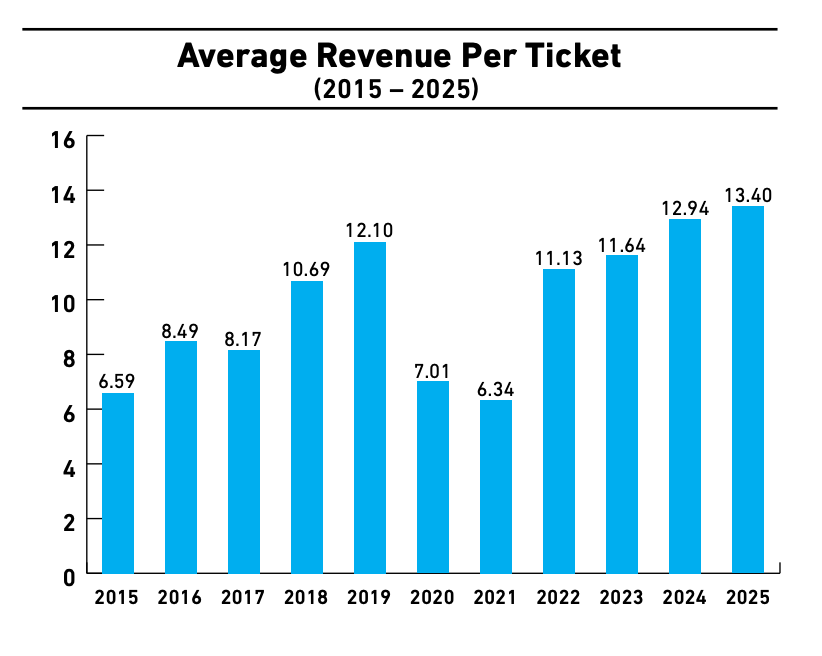
And the seat-filling matters. Not just as a metric. As a signal.
When more people are filling more seats and paying more per seat simultaneously, that’s not inflation. That’s not just “post-COVID bounce.” That’s people deciding, consciously, repeatedly, in larger numbers each year, that the experience of watching a film in a room with strangers is worth something that watching it alone on their couch is not.
That’s an audience that has decided it wants to be an audience.
There’s also this: roughly a quarter of all film festival attendance is now virtual.
Not 80%, like it was during the pandemic. Not trending toward zero, like a lot of people assumed it would once theaters reopened. About a quarter. Holding steady. Refusing to go away.
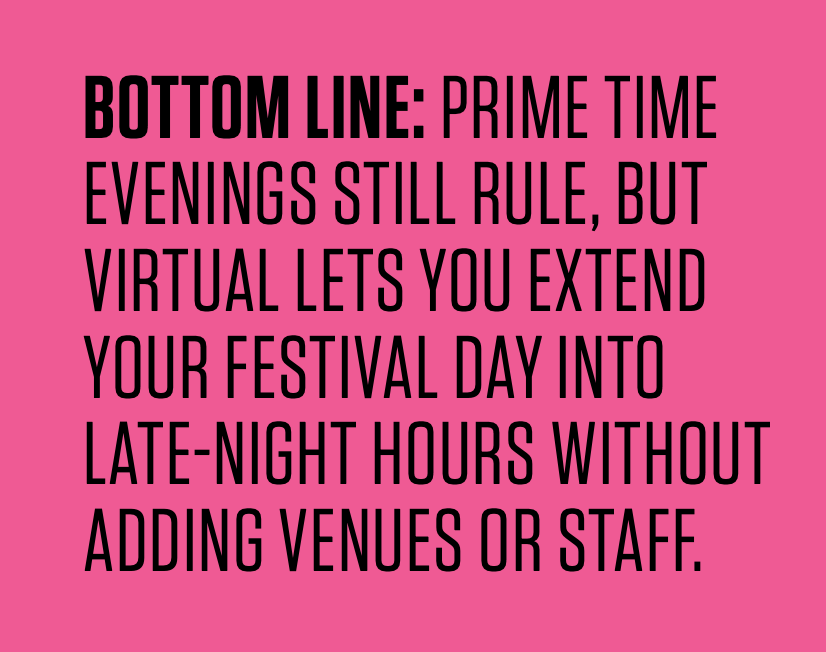
Which tells you something about who film festivals are actually for.
They’re not only for the people who can afford to stay a week in Park City (or Boulder). They’re not only for the people who live within driving distance of a venue. They’re for the person in Coos Bay who wants to watch an environmental documentary on a Friday night. They’re for the person in a rural county who follows the QDoc Film Festival because it’s one of the few places that reflects their life back at them.
Virtual didn’t replace in-person. It found the people in-person couldn’t reach.
That’s not a consolation prize. That’s the whole point.
A filmmaker might screen a short in McMinnville, meet collaborators in Bend, and later premiere a feature in Portland.
That sentence comes from “The Power of Film Festivals,” and it does something that most policy documents don’t do: it describes a career path that actually exists. Not the career path we see celebrated, the one that goes: make film, get into Sundance, get a distribution deal, become known. The career path that happens to real people in real places, moving between real communities, building something that looks less like a ladder and more like a web.
Audience.
The whole thing is connected. Pull one strand and it matters. Add one strand and it matters. The Manzanita Film Festival on the coast isn’t a footnote to Portland Panorama. It’s part of the same structure. The Eagle Cap Film Festival in Enterprise isn’t planning its first year just to be a small version of something bigger somewhere else. It’s doing something that nothing bigger somewhere else is doing. And it’s doing it in Enterprise and Joseph.

There’s a reasonable argument that Oregon’s film festival economy is significantly larger than the numbers currently on record. The most comprehensive study of its economic impact was published in 2017. A lot has happened since 2017. The industry has grown. New festivals have launched. Hybrid models have expanded reach. A filmmaker can now screen their work at a Portland festival and have a virtual ticket buyer in Medford watching the same night.
The 2017 numbers are not wrong. They’re just old.
That matters when you’re making the case, to legislators, to tourism boards, to grant-making bodies, for why film festivals deserve the same institutional attention we give to sports arenas and convention centers and all the other things we’ve decided count as economic engines.
They have an impact. Not just on filmmakers. But on locals. On Travelers. On the audience.
The festival doesn’t create the work itself. It creates the context for the work. The room. The people watching. The conversation after the credits roll. The moment where a filmmaker from La Grande sits across from an audience in Ashland and both of them realize, possibly for the first time, that what they made and what they needed to see are the same thing.
You can’t put a dollar amount on that.
Or rather: you can, and it’s probably larger than whatever number you’re currently using, but the dollar amount is not really the point.
The point is that Oregon, more or less by accident and then very much on purpose, built a film culture that looks like the state it lives in.
Connected. Creative.
Fifty festivals. One ecosystem.
And an audience to watch them.
Good to know! I’m sharpening my elbows to squeeze into the Oregon film fray this fall. Look for ‘Women of BACKBONE’ mini-doc.