
Connection.
"The Bridge" Provides Key Ingredient to Creative Success.

There’s a filmmaker in Bandon, on the Southern Oregon coast, making a debut feature rooted in the place where she lives - in its rituals, its rural American life, its particular relationship to land and season and community.
There’s a filmmaker in Eugene, of Ryukyuan descent, whose work has screened at the Rotterdam Film Festival and LACMA and Indie Memphis, and who was previously a fellow at the Sundance Directing and Screenwriting Labs.
There’s a filmmaker in Portland, a Pulitzer Prize finalist, documentary director, journalist, making a film about the city’s reckoning with its own toppled monuments to westward expansion.
There’s a filmmaker who went through Jordan Peele’s No Drama Initiative. A filmmaker in Ashland whose debut feature premiered at SXSW, won four Best Narrative Feature awards, and is now seeking financing for her second. A filmmaker of Nigerian-American descent who founded a nonprofit to empower filmmakers of color and has two features behind him. A Taiwan-born director with extensive stage experience working alongside a writer and producer with twenty years of film, television, and fiction podcasting experience.
A pair of filmmakers - married, working together - whose first short is premiering this year, their first feature already a Final Draft Big Break quarter finalist. A Mexican-American director who is an AFI Directing Workshop for Women graduate and a winner of the Best U.S. Latina Director at LALIFF. And a filmmaker/actress working on her first feature film which is a love letter to caregivers born of her experience in caring for her mom during her final years.
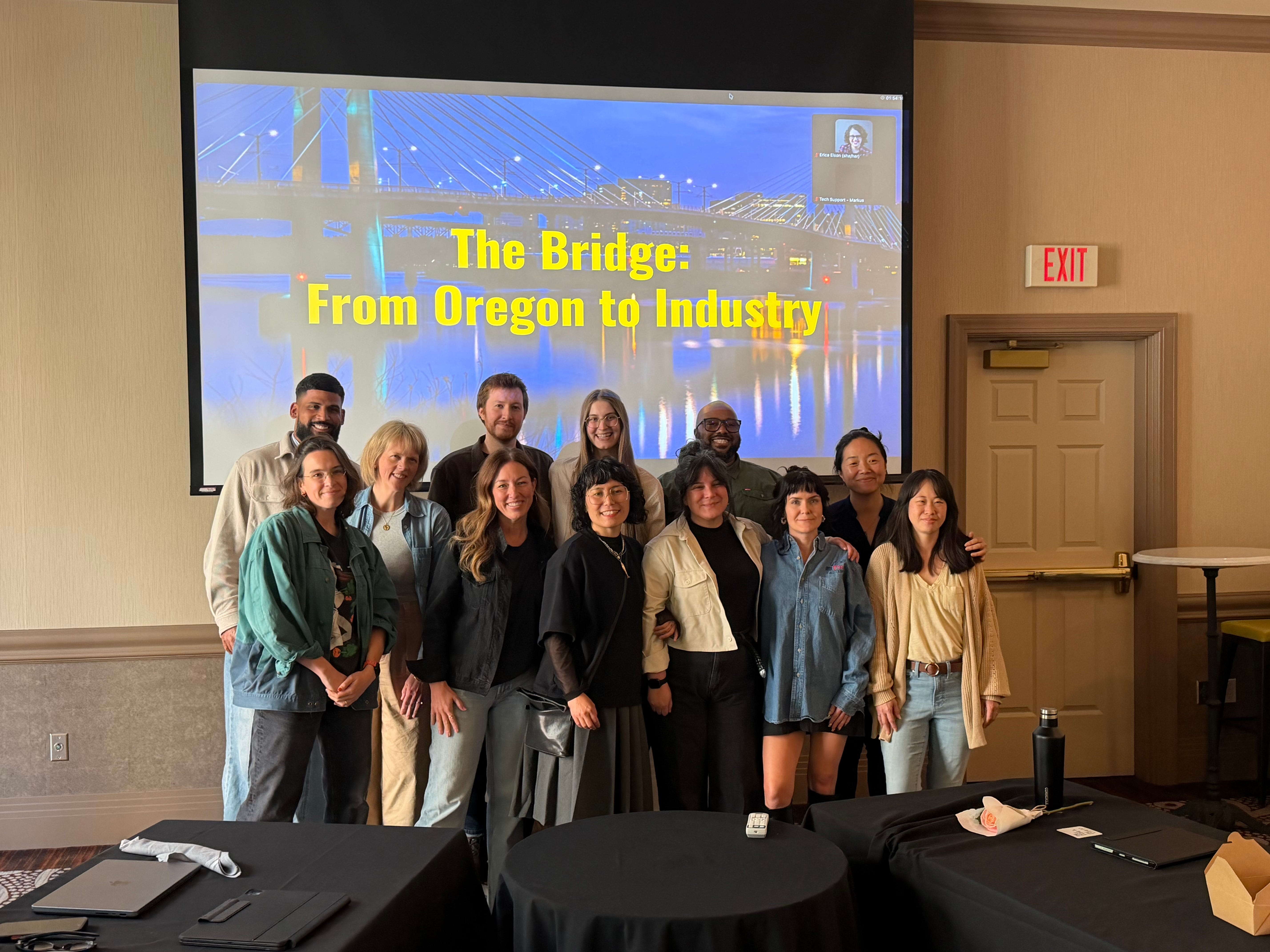
Twelve people. From Portland and Eugene, from Ashland and Bandon. Already working. Already making things that are real, that have screened, won awards, and changed the people who watched them.
They knew of each other but they were not connected. They knew of the pathways some filmmakers take and they knew of the success stories that some filmmakers have enjoyed but they were not connected to the Industry (capital “I” intended) as much as they needed to be.
The Bridge: From Oregon to Industry was designed to do just that.
Launched in 2026 as a partnership between Oregon Film, the Portland Events and Film Office, Prosper Portland, and Sundance Collab - the global community arm of the Sundance Institute, now reaching members in more than 170 countries - the program brought this first cohort together at the Dossier Hotel in downtown Portland for a weekend intensive in May, which will be followed by individual one-on-one mentorship sessions in the weeks after.
Yes, the program is about connection. But it is also about place. It’s about here. About Oregon. About Portland. It’s about the talent that lives here and the stories they are telling.
And this isn’t a for-profit program. There are no entry or participation fees. Participants and Presenters are together, staying in rooms on the floors above the ballroom where they meet. They come together to discuss, learn, meet and laugh.
After a welcome, some sharing of stories and an informal get together on Friday evening, the sessions run across Saturday and Sunday.
Festival strategy and publicity. Negotiation - an active, performance laden, goal orientated full workshop, not a lecture. An energetic and fun session on scheduling, budgeting, preparing a film for financing. A broad based look at the legal frameworks for independent filmmakers and the agreements and discussions that they should be having at the onset of any creative venture. The success story of a world renown and awards garnering impact campaign and its practical implementation on other issue-themed projects. The role of the producer in a rapidly changing landscape and how to look at projects from multiple angles. A bespoke project-by-project, filmmaker-by-filmmaker review of how to approach grants and labs. An innovative look into new models in financing and revenue - workforce development financing, broadening IP through graphic novels and art museum sales. The “marriage” of producer and director and how to make the most of that relationship. Sales, distribution, and how to approach a career.
That list reads like a curriculum and it is one. But the people delivering it are not faculty in the conventional sense. They are practitioners. Among them are a producer whose documentary won both the Sundance Documentary Audience Award and the Oscar for Best Documentary Feature; a writer/director whose first feature, a neo-Western thriller, won a Spirit Award nomination and worldwide distribution; an entertainment lawyer who built her practice from a solo office on the Universal Backlot into a firm of over twenty attorneys, founded specifically to help independent filmmakers bring their work to life; a distribution producer who founded a company that supports films through release without taking rights; a producer whose films have moved from Sundance to Venice to Cannes to HBO; a former studio executive who has bought and sold independent features on both sides of the table and built one of the nation’s most successful horror franchises; two producers whose collective credits include some of the most quietly essential American films of the past fifteen years, all shot in Oregon.
Some of these experts and innovators live here in Oregon, some of them came in just to share their experience in person and some of them zoomed in from places like New York and Los Angeles.
Between sessions, the connection continued in the form it always takes when it’s working; personally.
During the walkaway lunches on SW Alder Street. In the lobby at the end of the day. At the Friday and Saturday night mixers. At the closing dinner at G Love on Sunday evening. The kind of transmission that doesn’t appear on a schedule but is, often, what people are really there for. The exchange of information that happens when a filmmaker who has just come through the financing session follows up privately with the advisor who delivered it. When two members of the cohort discover they are making films about adjacent subjects or went through the same workshop in different years. When someone realizes, sitting across from a producer who built a twenty-year career without leaving the Pacific Northwest, that leaving is not actually the prerequisite it was implied to be.
That’s what The Bridge was striving to do: prove that you can have these careers here and you can be successful at it.
Two days of sessions on financing structures and distribution models and legal frameworks also produced something less quantifiable: Twelve filmmakers from across the state who came in as individuals leave as something more than that, a creative team. A creative force.
Portland and Oregon already contribute nearly $200 million annually to the state’s economy through film production. Portland’s Mayor announced the program with that number in the frame. It matters. Economic contribution is real and it is the language that legislators and tourism boards and city councils respond to.
But the filmmakers in this cohort are not thinking about the $200 million.
They are thinking about the film set in the cranberry bogs of Bandon that now has a clearer path to financing. The documentary about Portland’s monuments that has a better sense of its distribution options. A second feature that is now a little less abstract as a financial proposition. A feature in development that now has slightly better odds of reaching the audience it was made for.
Connection is not a metaphor here.
It is a legal structure understood. A financing pathway clarified. A negotiation approached with knowledge instead of anxiety. An advisor’s phone number in a pocket. An inspiration. A plan.
It is two filmmakers who didn’t know each other before Friday night who are now, on Sunday evening, talking about the possibility of collaborating.
A community that was already here, now just better connected.